


Does Meta have a looming attrition problem?
I am predicting that Meta’s senior employee retention will fall off of a cliff after February 2027. A date that many within Meta have begun referring to as “The Rapture”.
This is Part 1 of a series that examines “The Rapture” in more detail trying to look at the impact on employee total compensation and what happens when the golden handcuffs come off.
It starts in February 2027
“The Rapture” actually begins in February of 2027.
February 15th, 2027 to be exact.
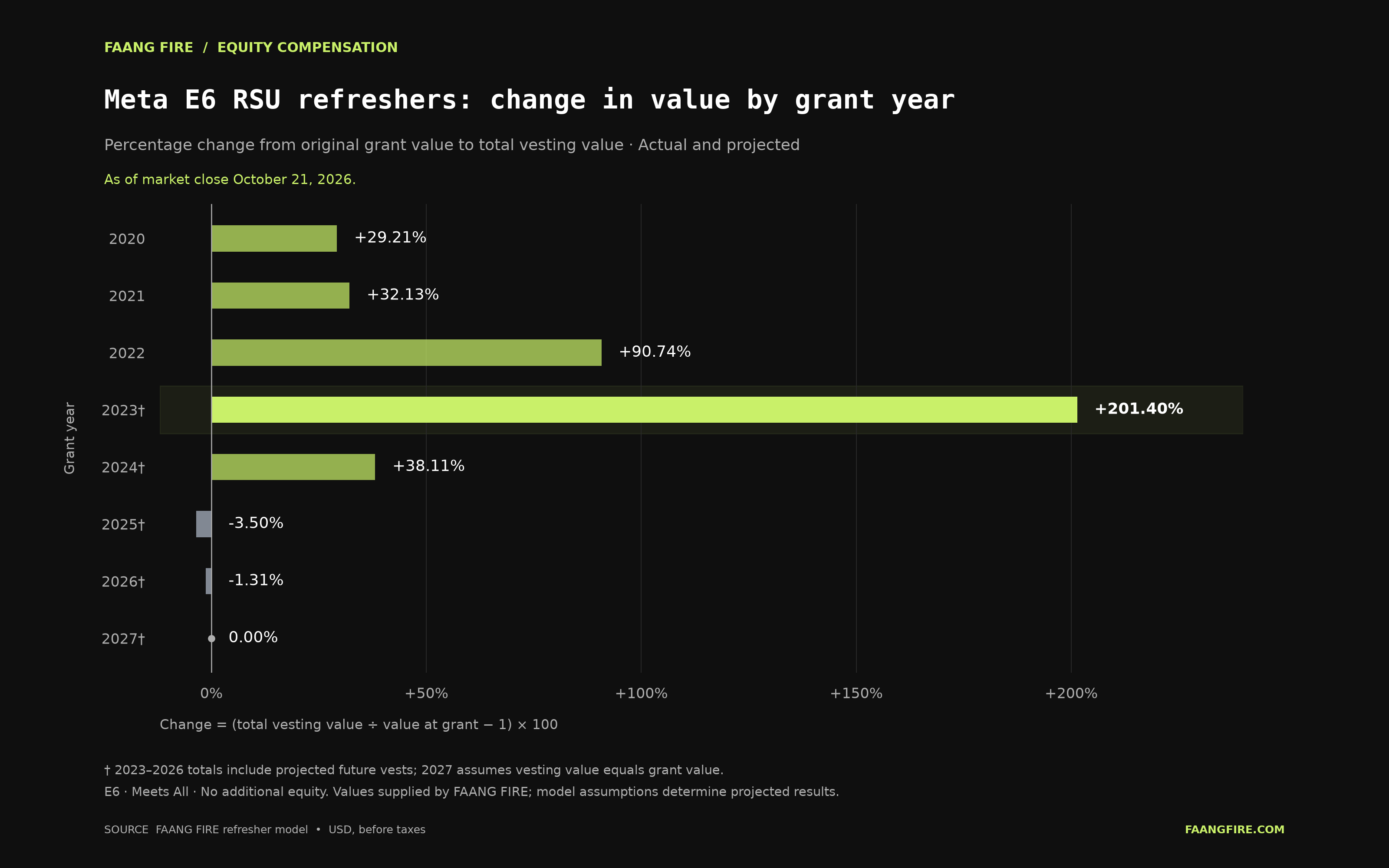
That’s the date of the final vest of the 2023 refresher. Based on my records, which go back to 2014, it’s on track to be the best-performing refresher Meta has ever awarded.
Including the remaining projected vests, that grant will have delivered more than three times its original value. A monumental 200%+ increase over the grant value!
The chart below compares each refresher’s original grant value with its total value at vest. Grants that haven’t finished vesting include projections.
I’ll use an E6 engineer in Menlo Park to show how this plays out in dollars.
But first, a word from our sponsor.
This Post is Sponsored by Frec

I’ve been using Frec’s direct indexing for over two years. This year alone, Frec has harvested more than $24,000 in tax losses that I can use to help offset capital gains as I diversify out of a concentrated RSU holding.
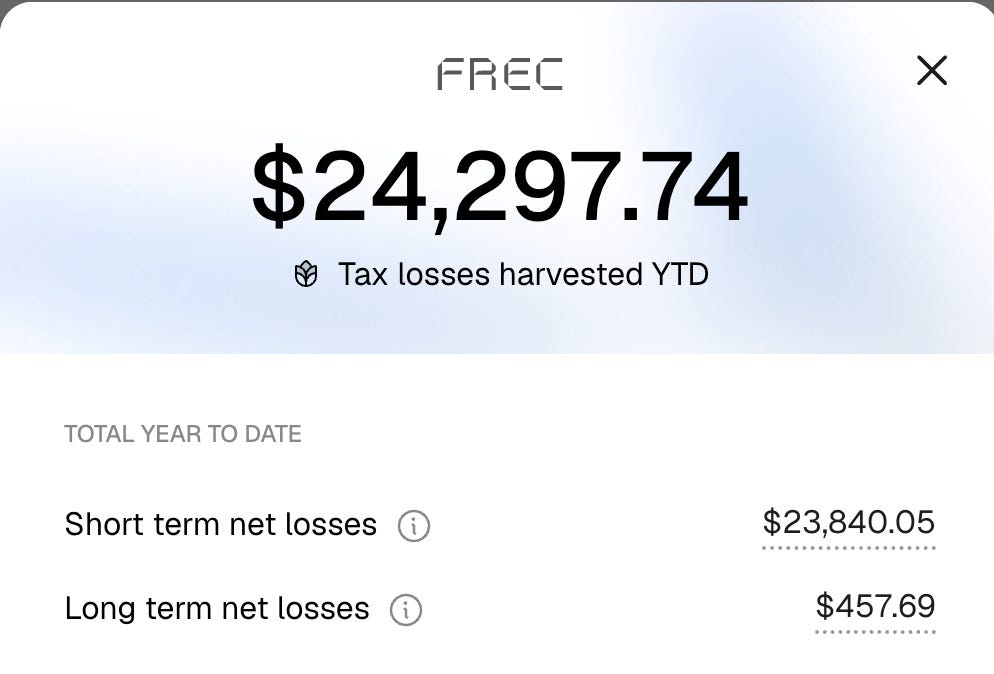
Instead of buying an ETF like VTI, Frec builds a portfolio of individual stocks designed to track the same market. This allows Frec to automatically harvest losses from stocks that are down, even when the overall market is up.
Frec just launched Nasdaq-100® direct indexing and added ETF funding to its Long Short Direct Indexing portfolios.
FAANG FIRE readers are eligible for a $250 sign-up bonus when they join Frec and invest at least $20,000 into an eligible portfolio. Frec offers Direct Indexing, Long Short Direct Indexing, and Diversify, which can help transition concentrated stocks into a diverse index while managing your tax impact.
Want to Learn More? Join Frec CEO Mo Al Adham and me for another FIRE-side chat + Q&A on October 28th at 12pm PT.
Note: I am a Frec client and Frec paid a one-time fee for this sponsorship. I also receive $250 for each referral that uses my link and earns $250 which creates an incentive for me to recommend Frec. Investing involves risk, including the risk of loss. Performance shown reflects a single client account invested from 1/1/2026-10/14/2026, tracking the CRSP US Total Market Index (excluding Uber stock). The account’s beginning value on 1/1/2026 was $316,290. The account received multiple contributions during the period for total contributions of $123,969. Performance is presented net of advisory fees. Past performance does not guarantee future results. May not be representative of other client experiences.
A Refresher on How Meta’s Stock Refreshers Work
Meta’s standard refreshers have historically been formulaic, based on role, level, location, and performance rating.
For this example, I’m using an E6 (Staff Engineer) in Menlo Park who consistently met all expectations, with no promotions or additional equity grants.
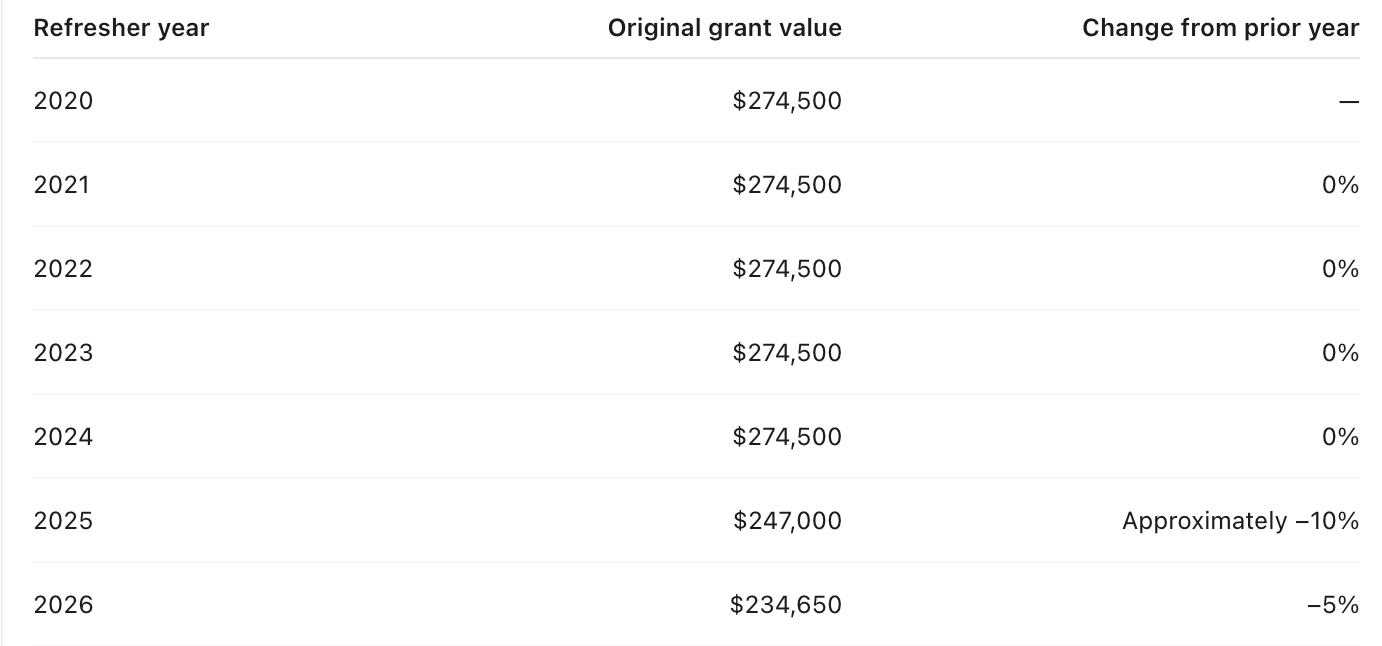
From 2020 through 2024, that employee would have received a $274,500 refresher each year, vesting quarterly over four years.
Each award is converted into RSUs when granted. Those shares vest over 16 quarters, so the amount the employee receives depends on Meta’s stock price at each vest.
Meta cut standard refresher values by approximately 10% in 2025 and another 5% in 2026. For this E6, the annual award fell from $274,500 to $234,650, a total reduction of about 14.5%.
Standard E6 refresher grants in Menlo Park:
How Overlapping Refreshers Normally Work
To understand the cliff, it helps to start with a simple case: assume the stock price never changes.
A $274,500 refresher split across 16 vests pays out $17,156.25 per quarter. With four of those grants vesting at once, that adds up to $68,625 per quarter, or $274,500 per year.
The chart starts in May 2023, with the 2020, 2021, 2022, and 2023 refreshers all vesting. Each color represents one grant.
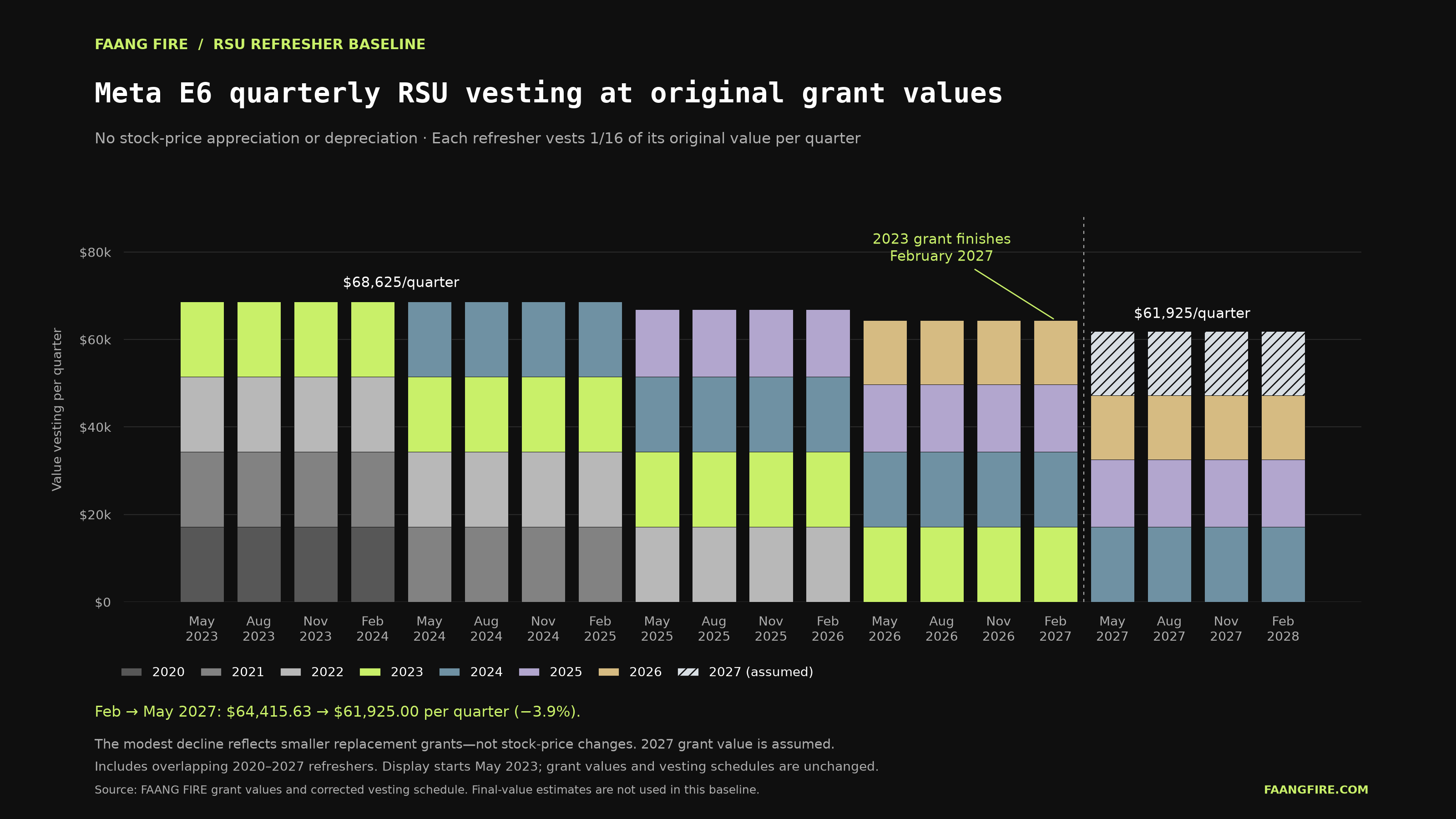
The 2020 refresher finishes vesting in February 2024, and the 2024 refresher starts in May. Both were $274,500 awards, so the quarterly payout stays the same.
Starting in 2025, the smaller refreshers replace larger grants, gradually bringing that payout down.
When the 2023 refresher ends in February 2027, the quarterly total falls from $64,415.63 to $61,925 in May, including the assumed 2027 refresher. That’s a modest decline of about 3.9%.
But Meta’s stock price didn’t stay flat.
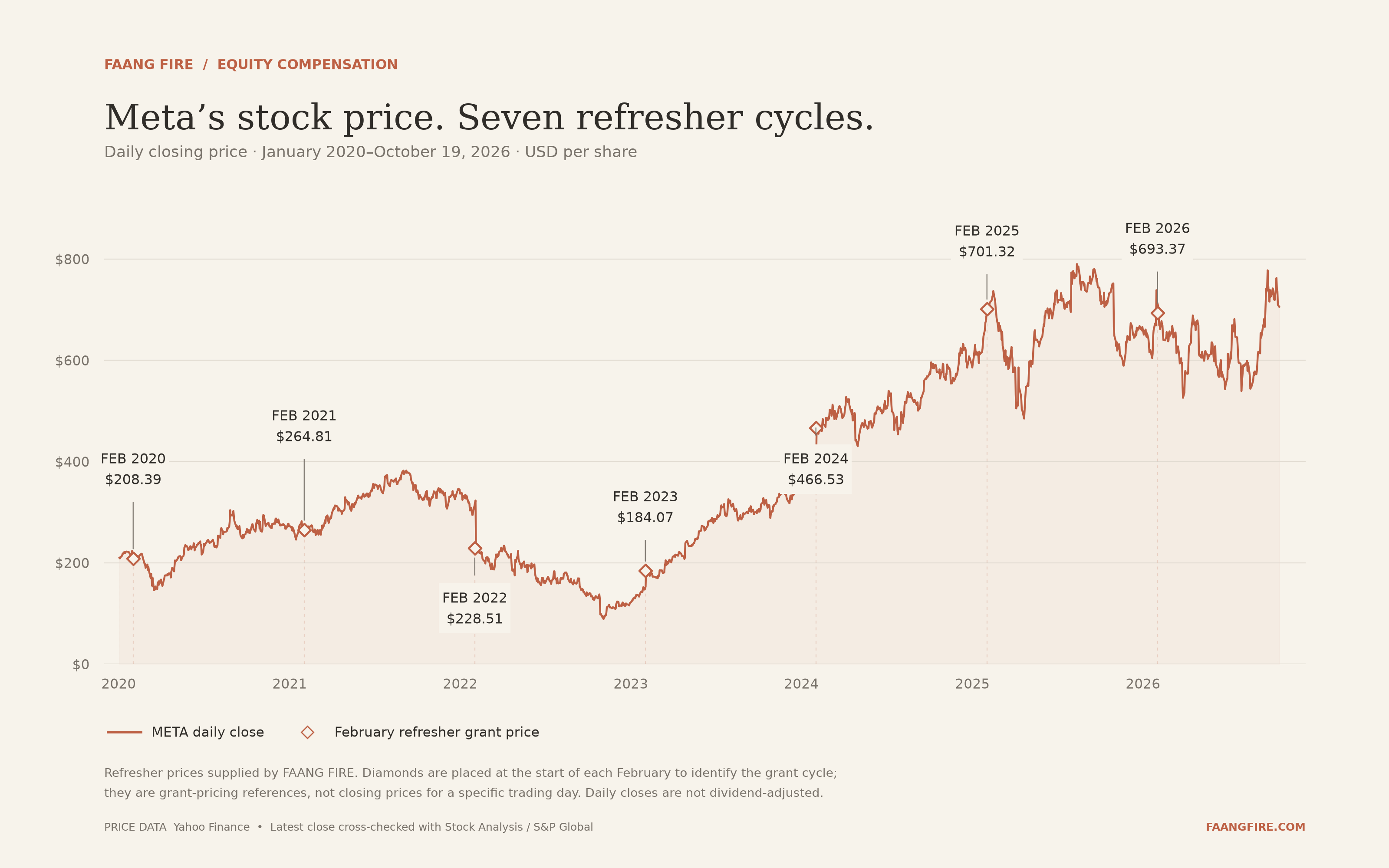
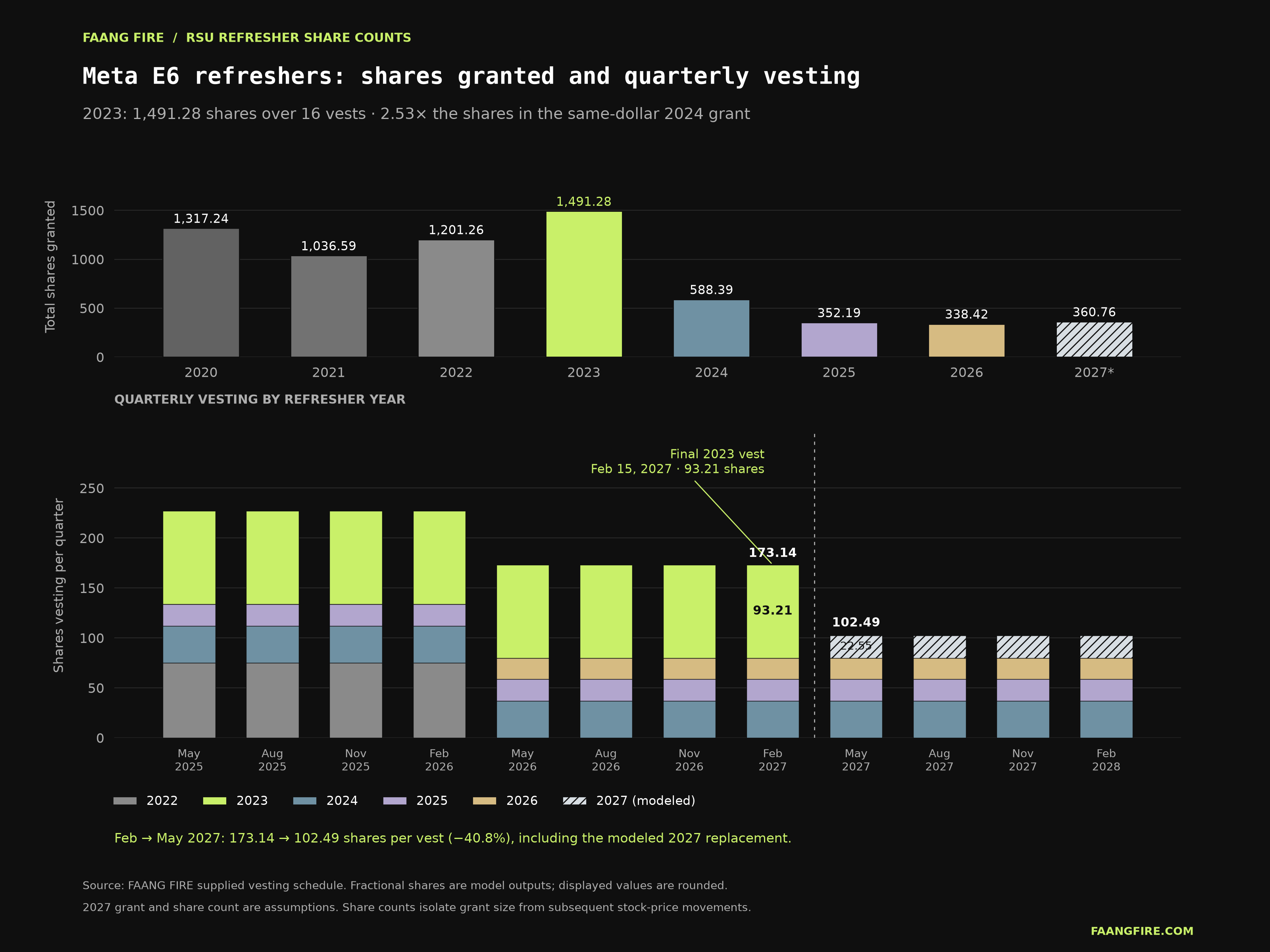
The 2023 refresher bought 1,491 shares, compared with 588 shares for the same $274,500 award in 2024.
That gave the employee more than twice as many shares benefiting from Meta’s stock recovery.
The bottom half of this chart shows how those grants contribute to each quarterly vest. The 2023 refresher pays out 93.21 shares per quarter through February 2027. The assumed 2027 refresher replaces that with 22.55 shares per quarter, starting in May.
Here’s what those grants are worth over their full vesting periods. Each bar separates the original grant value from its gain or loss. For grants still vesting, the total includes projected future vests.
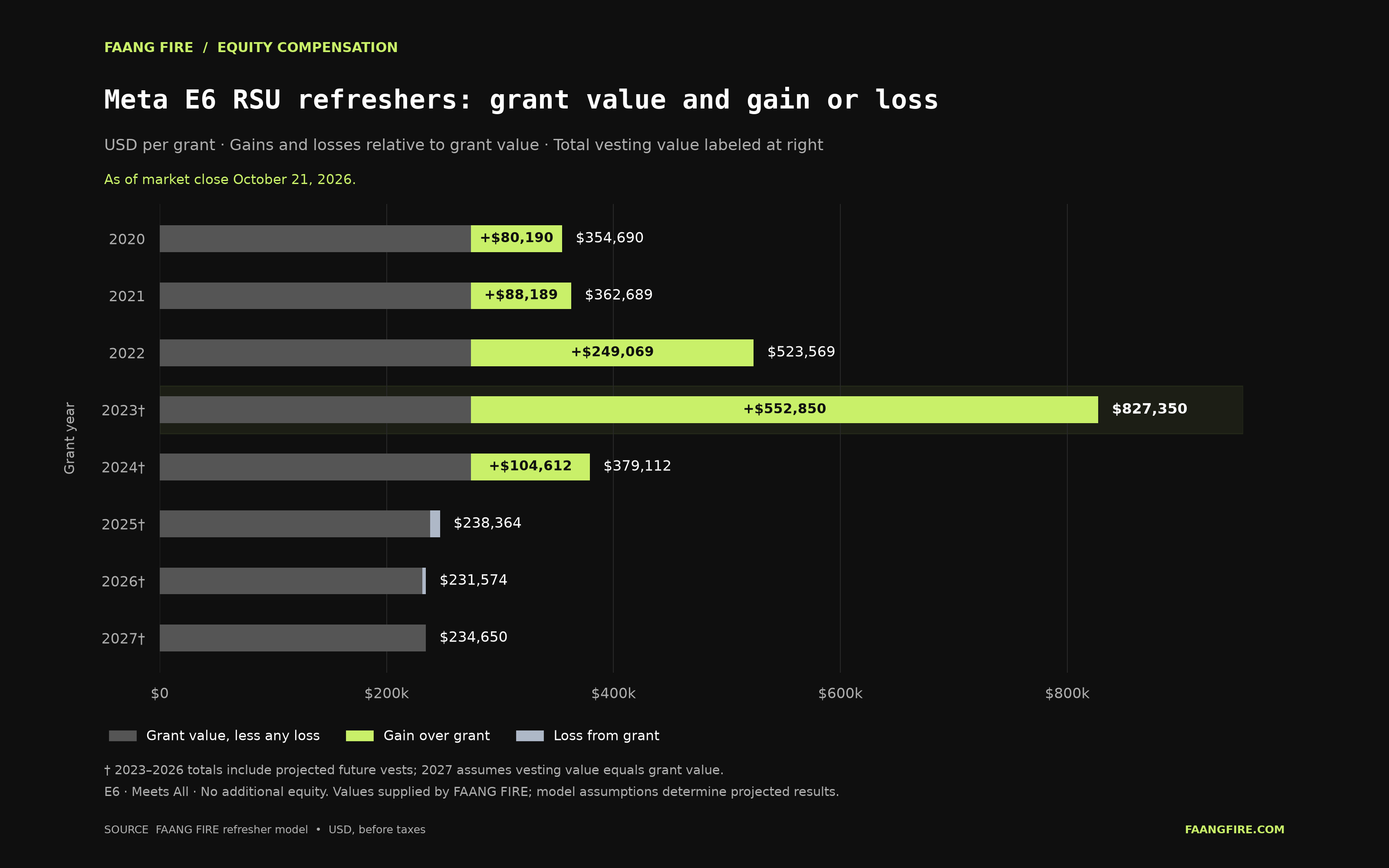
The 2023 and 2024 refreshers both started at $274,500, but the 2023 grant bought more than twice as many shares. Meta’s stock recovery then made those shares substantially more valuable.
This E6’s quarterly RSU payout is projected to fall from $120,770 in February 2027 to $71,566 in May, including the assumed new refresher.
That’s $49,204 less per quarter, a 40.7% drop in equity compensation.
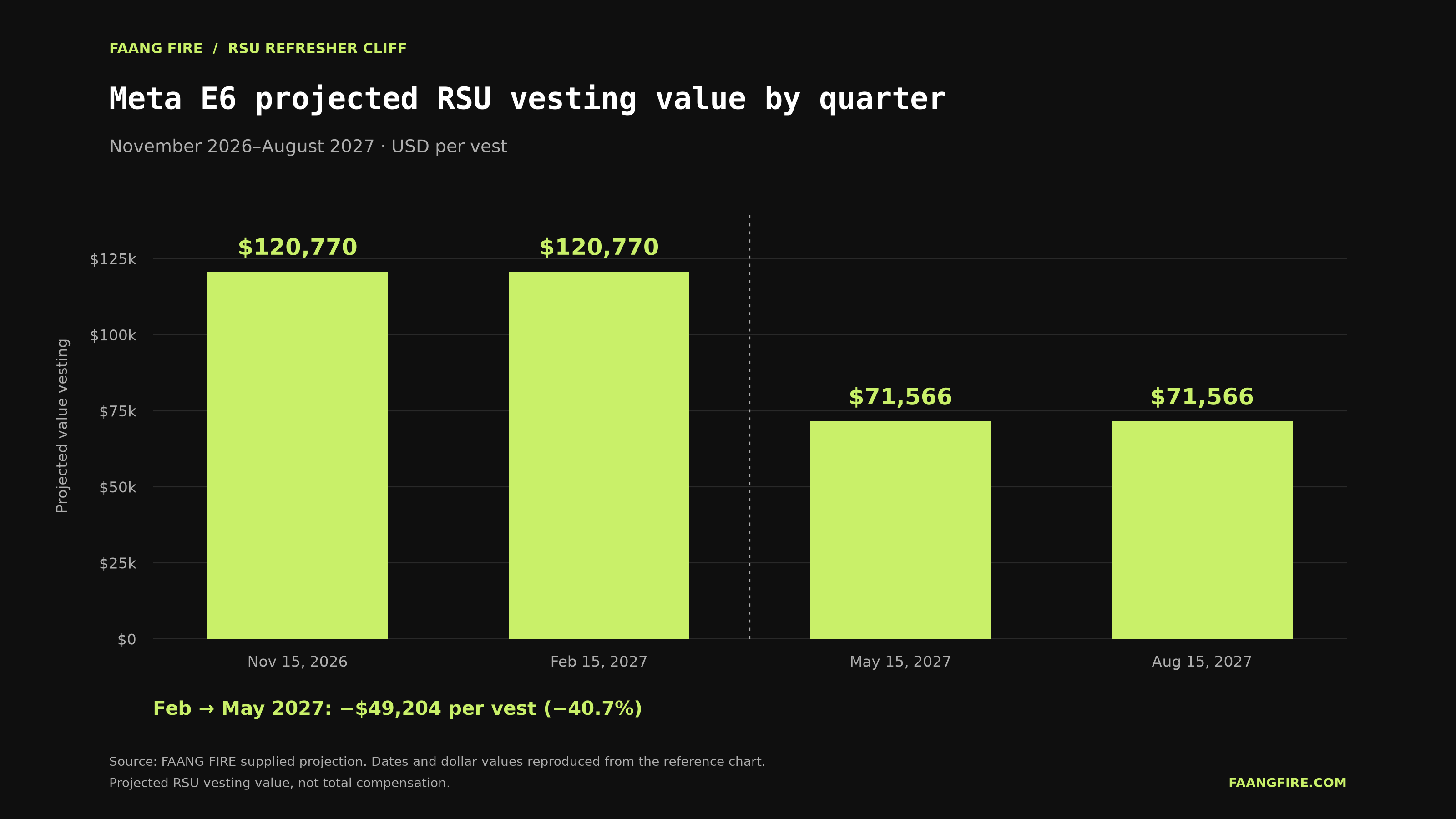
Nearly $200,000 less in annualized compensation from RSUs alone.
The Rapture.
Does Meta Care About the Rapture?
This example assumes an E6 who keeps meeting expectations, with no promotions or additional equity. Higher ratings, promotions, and retention grants can make the cliff smaller or eliminate it.
Meta can offer additional equity to people it wants to keep. If other employees leave and their roles aren’t backfilled, the company can reduce headcount without another round of layoffs.
So perhaps some of this attrition is a feature, not a bug. Of course, Meta doesn’t get to choose who leaves.
For employees approaching this cliff, it’s worth remembering how unusual these past few years have been. This was a generational run for those who stayed long enough to collect the vests. I was laid off in May 2023, before most of that rise.
For some employees, those payouts may have brought financial independence years closer. Maybe 2027 is the year they decide they have enough and finally FIRE by choice.
Are you approaching the cliff?
In Part 2, I want to look at actual compensation histories, including salary, bonuses, promotions, and additional equity. How much is total compensation dropping, and is it changing anyone’s plans?
If you’re at Meta and this affects you, reply to this email. Are you waiting for that last vest? Staying regardless? Has a promotion or retention grant changed the math?
I’m looking for people willing to share their compensation and vesting data for anonymized examples. We can start with a conversation and agree on what can be published.
Subscribe to get Part 2 of The Meta Rapture.